World Models
10 min read
Compress pixels into a latent state, learn how that state evolves, then let a tiny controller act through the model's predictions or train entirely inside its imagined world.
the split
Put most of the intelligence in a learned world, not the policy
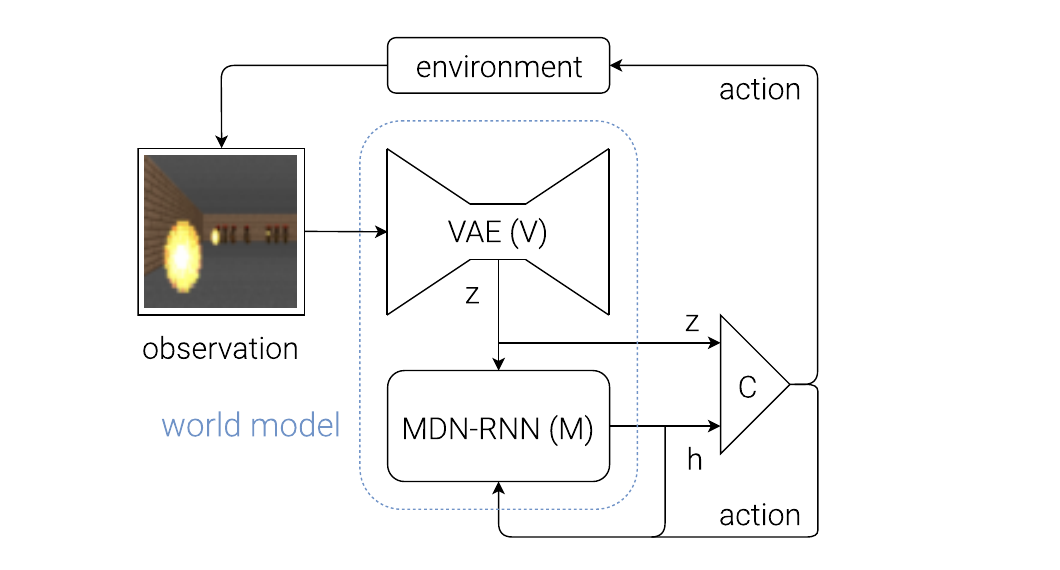
The agent is deliberately divided into vision, memory, and control. V and M learn reusable structure with gradient descent; C searches a much smaller reward-driven parameter space.
vision
VAE compresses each frame
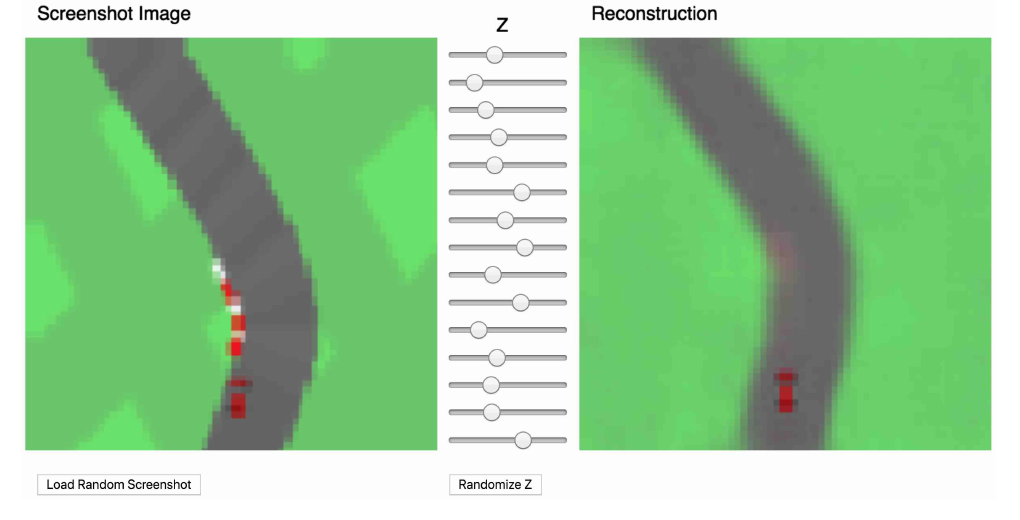
A convolutional VAE turns a high-dimensional observation into a compact Gaussian latent. The decoder makes the compression visible, but the controller only needs z.
4,348,547 parameters in CarRacing
memory
MDN-RNN predicts what comes next
An LSTM reads the current latent and action. Its mixture-density head represents several plausible next latents instead of blurring them into one deterministic guess.
422,368 parameters and 256 hidden units in CarRacing
controller
A linear policy chooses the action
The current visual code says what is here. The recurrent hidden state says what has happened and what is likely next. A single layer maps both directly to control.
867 reward-trained parameters in CarRacing
Observe
pixels xₜ
Compress + remember
zₜ and hₜ
Act and update
aₜ changes the next observation
training recipe
Learn representation first, solve credit assignment second
The modules are trained separately. This avoids asking a sparse reward signal to shape millions of visual and recurrent parameters at the same time.
- 1
Collect experience
Run a random policy for 10,000 rollouts and store every RGB frame and action.
real environment
- 2
Learn spatial codes
Train V to reconstruct each frame while regularizing its latent toward a Gaussian prior.
framewise VAE loss
- 3
Learn latent dynamics
Encode the dataset, then train M with teacher forcing to predict the next latent distribution.
sequence likelihood
- 4
Evolve the policy
Freeze V and M. CMA-ES searches C's weights using average cumulative reward as fitness.
black-box optimization
The useful bargain: V and M absorb almost all model capacity without seeing reward. Only the tiny C model sees the task objective, so evolution searches hundreds of parameters instead of millions.
experiment one
Prediction features turn a snapshot into a driving state
CarRacing isolates the value of memory. All variants see the VAE latent; only the full model also receives the MDN-RNN hidden state that was trained to predict the future.
Average reward over 100 trials
V only
linear C reads zₜ
632 ± 251
V + hidden C
zₜ plus a 40-unit MLP
788 ± 141
V + M
linear C reads zₜ and hₜ
906 ± 21
Bar lengths encode the reported mean only. The printed values include the paper's standard deviations.
what hₜ adds
Predictive context
A frame can show where the road is, but not the car's velocity or which way it has been turning. The recurrent state summarizes the recent sequence and the distribution of likely next frames.
The full model reaches 906 ± 21, clearing the environment's 900-point solve threshold.
experiment two
Once M predicts termination, it becomes the environment
For VizDoom Take Cover, M predicts both the next latent and the probability of death. That is enough to expose a Gym-like interface and optimize C without rendering pixels or running the game engine.
Reality supplies the dataset
VizDoom frames
z sequences
A random policy collects 10,000 real rollouts once. The VAE and dynamics model learn from that fixed experience.
The controller trains inside a latent dream
C reads zₜ, hₜ
outputs aₜ
M samples next step
zₜ₊₁ + doneₜ₊₁
Repeat until done
reward = time alive
The VAE decoder is optional during training. It only renders the latent trajectory for humans; C and M operate directly on vectors.
train in dream
959
best average over 1,024 virtual rollouts
deploy in reality
1092 ± 556
average survival over 100 real trials
solve threshold
750
required average survival time
the reality gap
A harder dream can teach a more transferable policy
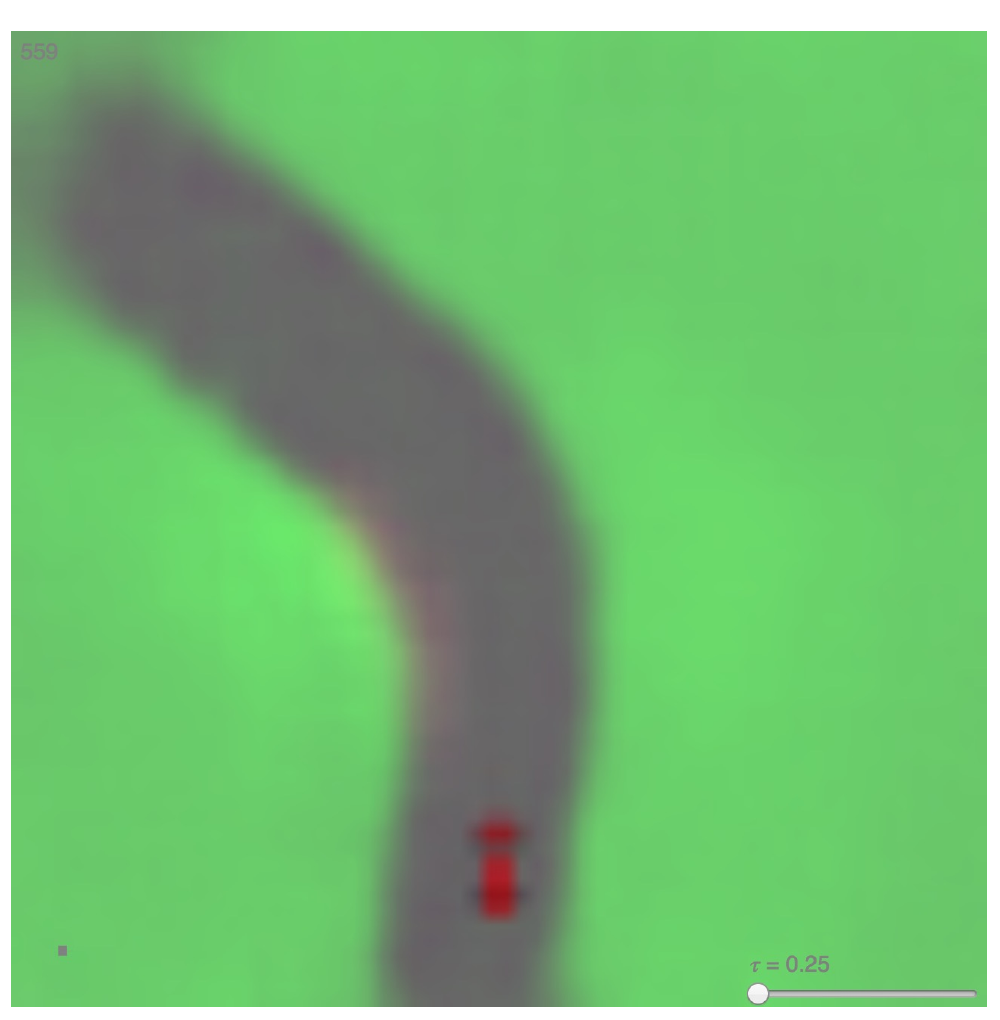
Controllers optimize whatever M permits. Temperature controls the diversity of MDN-RNN samples, trading an easy but exploitable simulator for a noisy but more robust training distribution.
VizDoom score by dream temperature
| temperature τ | virtual score | actual score |
|---|---|---|
| 0.10 | 2086 ± 140 | 193 ± 58 |
| 0.50 | 2060 ± 277 | 196 ± 50 |
| 1.00 | 1145 ± 690 | 868 ± 511 |
| 1.15used | 918 ± 546 | 1092 ± 556 |
| 1.30 | 732 ± 269 | 753 ± 139 |
Low temperature rewards cheating
At τ = 0.10, mode collapse makes monsters stop firing. C nearly perfects the dream, then performs below the random-policy score in reality.
Moderate noise acts like domain randomization
At τ = 1.15, uncertain fireballs make the dream harder than the real game. A policy that survives that nightmare transfers well.
Too much noise erases the lesson
Temperature is still a hyperparameter. At τ = 1.30, the policy becomes less variable but its average real score falls.
the deeper limitation
The policy finds model errors, not just task solutions
Coverage
Random rollouts are sufficient here, but harder worlds need an iterative loop that collects data where the current model is weak.
Relevance
A reward-free VAE may discard tiny details that matter for the task. Joint training can recover them, but reduces reuse across tasks.
From the paper
The learned loop and the world it imagines
The original figures make three ideas concrete: how V, M, and C close the control loop; which visual details survive compression; and what a rollout sampled entirely from the learned dynamics looks like.
The mental model
World Models separates representation learning from control. The VAE compresses each image into z, an MDN-RNN turns the recent latent and action sequence into a predictive hidden state h, and a linear controller maps [z, h] to the next action. Most parameters learn from abundant observations; only the tiny controller must solve the reward-driven search problem.
The recurrent model has two jobs. Its hidden state is a compact feature for acting in the real environment, as the CarRacing result demonstrates. When it also predicts episode termination, it can replace the environment during training. The VizDoom controller is optimized against sampled latent trajectories, then transferred back to the real game without task training there.
The dream is useful precisely because it is imperfect, but its imperfections are also the main risk. An optimizer will exploit any shortcut the learned dynamics allow. Raising sampling temperature makes those shortcuts less reliable and produces a more robust policy, up to the point where the simulated world becomes too noisy to teach anything. The lasting idea is not that models must predict every pixel perfectly; they must preserve the dynamics needed for a policy to succeed outside the model.
Sources