ENPIRE: Agentic Robot Policy Self-Improvement in the Real World
7 min read
Give coding agents a repeatable physical experiment loop, then let them improve training recipes across a fleet of real robots.
NVIDIA / CMU / UC Berkeley · June 2026
The idea to remember
Autonomous robot research needs an environment that can reset, execute, and judge experiments repeatedly. ENPIRE builds that interface first, then lets coding agents search over policy and training code using real-world feedback.
What improves: Initially the safety, reset, and reward tools; after those are fixed, the policy implementation and learning recipe. Depending on the experiment, BC or RL policy parameters also train.
The architecture
How the improvement loop works
Step 1
Build the environment
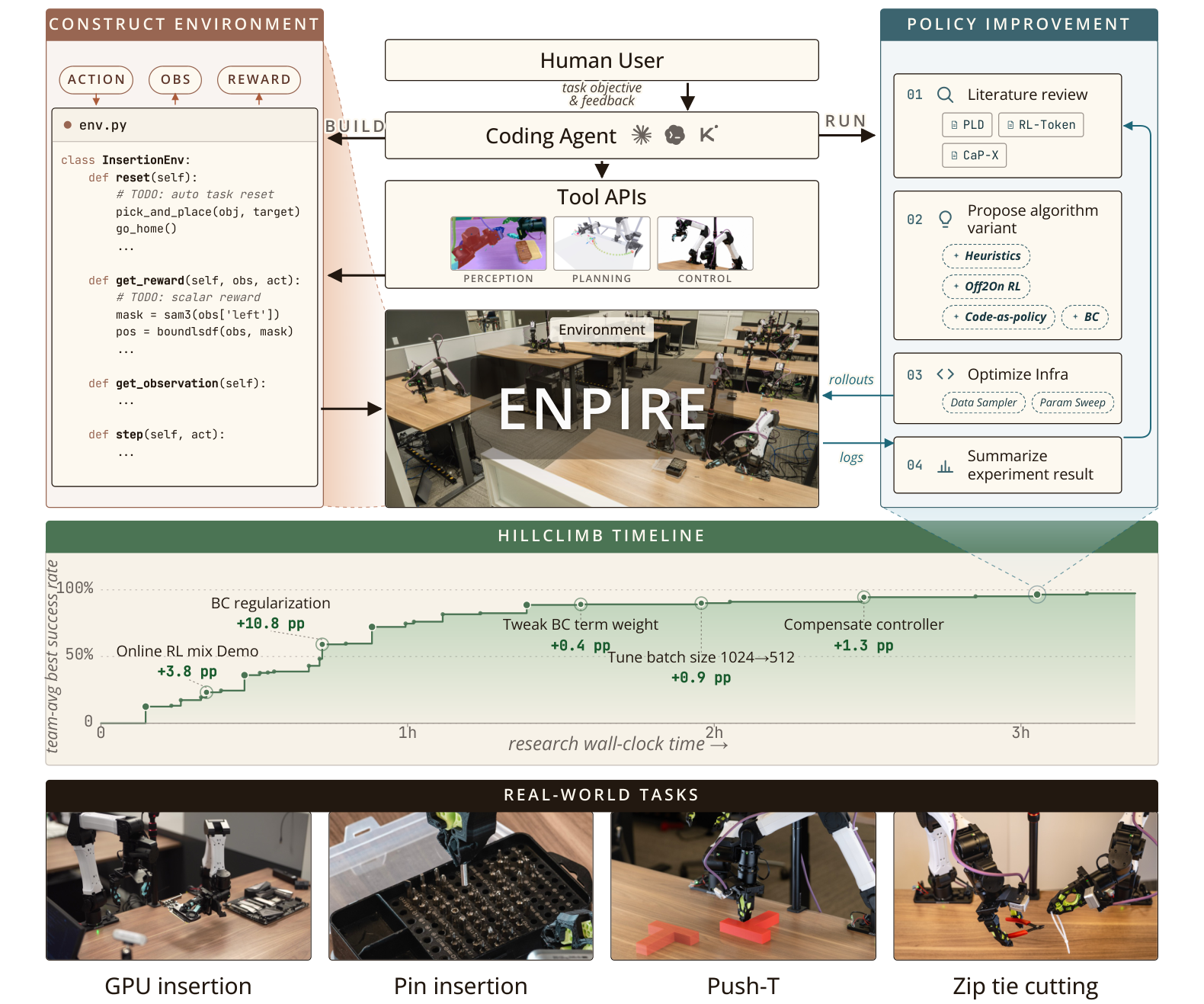
Agents use human setup feedback and labeled examples to implement safety limits, scene resets, and success verification. Validate these tools offline and freeze the APIs.
Step 2
Run physical autoresearch
Launch a policy, collect rollouts, inspect rewards and logs, and alter heuristic control, tool use, behavior cloning, or reinforcement-learning code.
Step 3
Share winning recipes
One coding agent works with each robot station. Agents branch, evaluate, and share useful changes through Git so physical experiments proceed asynchronously.
What the agents do
- Environment-building agent
- Writes procedural safety checks, resets, and binary outcome verification. Human feedback shapes this stage before the interface becomes immutable.
- Policy research agent
- Reads rollout logs, forms hypotheses, edits code, launches training, and evaluates the resulting policy against the fixed environment APIs.
- Fleet of agent–robot pairs
- Eight bimanual YAM stations each have hardware, cameras, compute, and a coding agent. There is no central robot-state coordinator.
- Git-mediated collaboration
- Agents share code, configurations, results, and training ideas through ordinary branches, merges, and cherry-picks. Each station can run and recover independently.
The environment is part of the research infrastructure
ENPIRE separates environment construction from policy improvement. In the first stage, agents can improve the verifier, reset routine, and safety tools using human feedback. Once validated, these become fixed Gym-style APIs for the second stage. This prevents a policy researcher from simply rewriting the success criterion to look better.
The acronym names the pieces: Environment (EN), Policy Improvement (PI), Rollout (R), and Evolution (E). Evolution here includes changing algorithm and infrastructure code, not only tuning a parameter vector.
Parallel robots buy faster experiments at a token cost
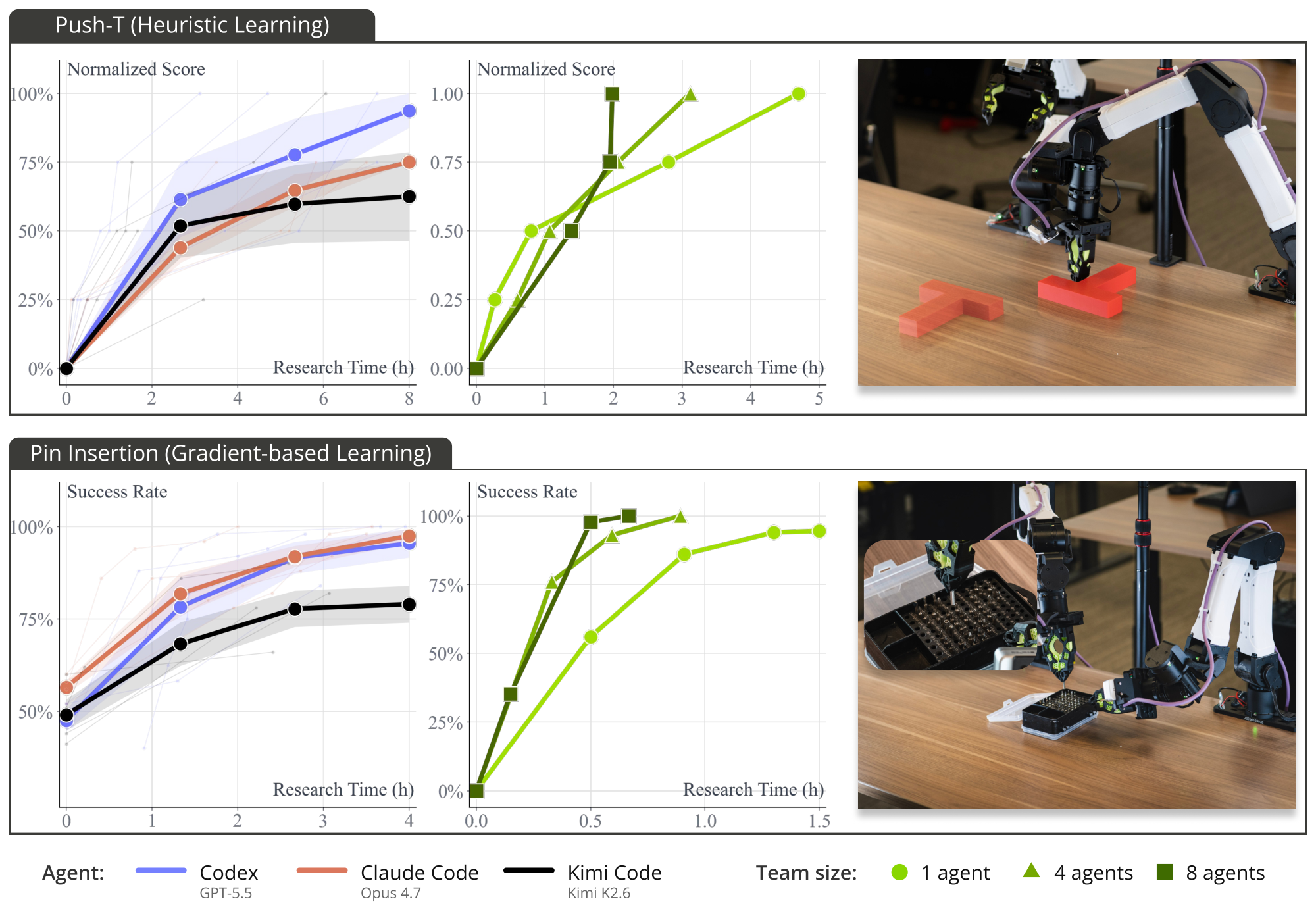
A station can evaluate an idea while another explores a different training recipe. Useful changes propagate through Git rather than synchronized gradients or streaming robot state. The fleet can compare and reuse discoveries while remaining loosely coupled.
On pin insertion, moving from one to eight agent–robot pairs reduces time to near-perfect performance from more than 1.5 hours to about 40 minutes. Token consumption grows faster than the wall-clock improvement. The paper therefore measures robot utilization and token utilization alongside success.
What the experiments show
- 99%
- Reported dexterous success
- Pin insertion and zip-tie cutting are representative physical tasks. The rollout protocol allows up to eight retries, including recovery after failure.
- 8 stations
- Physical research fleet
- Each station has two YAM arms, cameras, local compute, and its own coding agent.
- ~40 min
- Eight-agent pin insertion
- Time to near-perfect success versus more than 1.5 hours with one agent–robot pair in the reported scaling study.
Where humans still contribute
- People prepare hardware and give setup feedback while agents construct environment tools. Reward design uses a few minutes of labeled successful and failed demonstrations and specified accuracy and latency targets.
- The infrastructure supports optional teleoperation. Human/manual transitions go into a separate demonstration buffer, while RL transitions populate the online replay buffer. This capability should not be read as evidence of teleoperation in every autonomous run.
How to read the result
- The reported success metric permits up to eight retries within a rollout. It measures recovery as well as precision and should not be interpreted as 99% first-attempt success.
- Autonomous policy improvement begins after the environment and its verifier are prepared. The system does not eliminate human effort from hardware setup or reward validation.
- More robots reduce time to discovery but can consume disproportionately more tokens. Results depend on the physical resource budget and the reliability of resets and reward checks.
Figures and numerical results are attributed to the linked paper. The step cards are explanatory summaries.