Diffusion Policy: Visuomotor Policy Learning via Action Diffusion
8 min read
Generate a coherent action sequence by repeatedly denoising noise, execute only its near-term prefix, then observe and plan again.
training
Corrupt a demonstrated plan, then learn to recover it
Training is supervised behavior cloning in action space. There is no reward, value function, policy gradient, or negative sampling loop.
Slice a demonstration
Pair the latest Tₒ observations Oₜ with the next Tₚ expert actions Aₜ⁰.
Add known noise
Sample a diffusion step k and Gaussian noise εᵏ, then corrupt the entire action sequence.
Predict the noise
Give the model Oₜ, the noisy actions, and k. It estimates the exact noise that was added.
Apply one MSE loss
Update the vision encoder and noise predictor so the estimated noise matches εᵏ.
one training example
Oₜ = [oₜ₋Tₒ₊₁, ..., oₜ]
Aₜ⁰ = [aₜ, aₜ₊₁, ..., aₜ₊Tₚ₋₁]
The observation window says what is happening now. The action window is the clean trajectory sketch the model must learn to generate.
noise-prediction objective
L = MSE(εᵏ, εθ(Oₜ, Aₜ⁰ + εᵏ, k))
Across many noise levels, the model learns the vector field that can turn random action sequences back into demonstration-like plans.
inference
Start with noise, then refine an action plan
The policy does not regress directly to one answer. It follows a learned score field that pulls a random action sequence toward the conditional demonstration distribution.
Sample noisy actions
Initialize the full prediction horizon Aᵏ from Gaussian noise. Different initial samples can enter different behavior modes.
Condition on observations
Encode recent images and robot state once, then provide that context and the diffusion timestep to the noise predictor.
Denoise repeatedly
Subtract predicted noise across K iterations. DDIM reduces the paper's 100 training steps to 10 inference steps.
Execute a short prefix
Run the next Tₐ actions, observe again, and repeat. The remaining prediction is a plan, not a commitment.
learned update
Aᵏ⁻¹ = α(Aᵏ - γεθ(O, Aᵏ, k) + noise)
why diffusion
The representation fits the shape of robot behavior
Robot demonstrations are precise, sequential, and often ambiguous. Diffusion handles those properties in one output representation.
Multimodal actions
Separate samples can commit to distinct valid strategies instead of averaging incompatible actions.
High-dimensional output
The model generates a whole action sequence jointly, which encourages temporal consistency.
Stable training
Noise prediction avoids the negative-sampling loop used to train normalized energy-based policies.
architecture
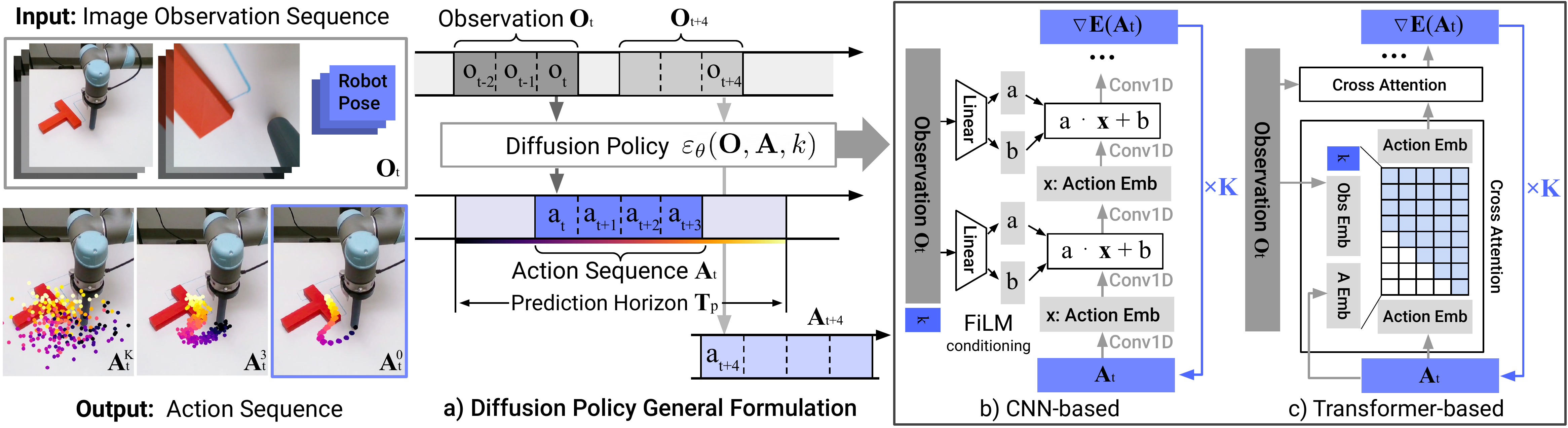
Two noise predictors, one conditional diffusion objective
The visual encoder is shared conceptually, but the action-sequence model can favor smooth trajectories or rapid changes.
CNN-based
Temporal U-Net with FiLM
A 1D convolutional network processes the noisy action sequence. Every block is modulated by the observation feature and diffusion timestep through channel-wise scale and bias values.
Transformer-based
Causal decoder with cross-attention
Action tokens use causal self-attention and read observation tokens through cross-attention. The paper finds this useful for tasks with high-frequency action changes and velocity control.
figures from the paper
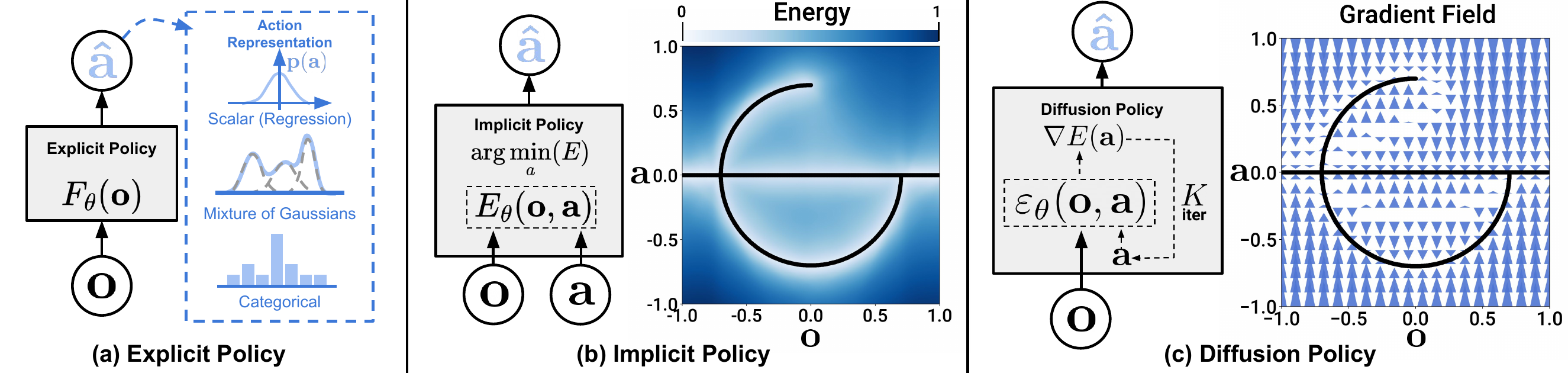
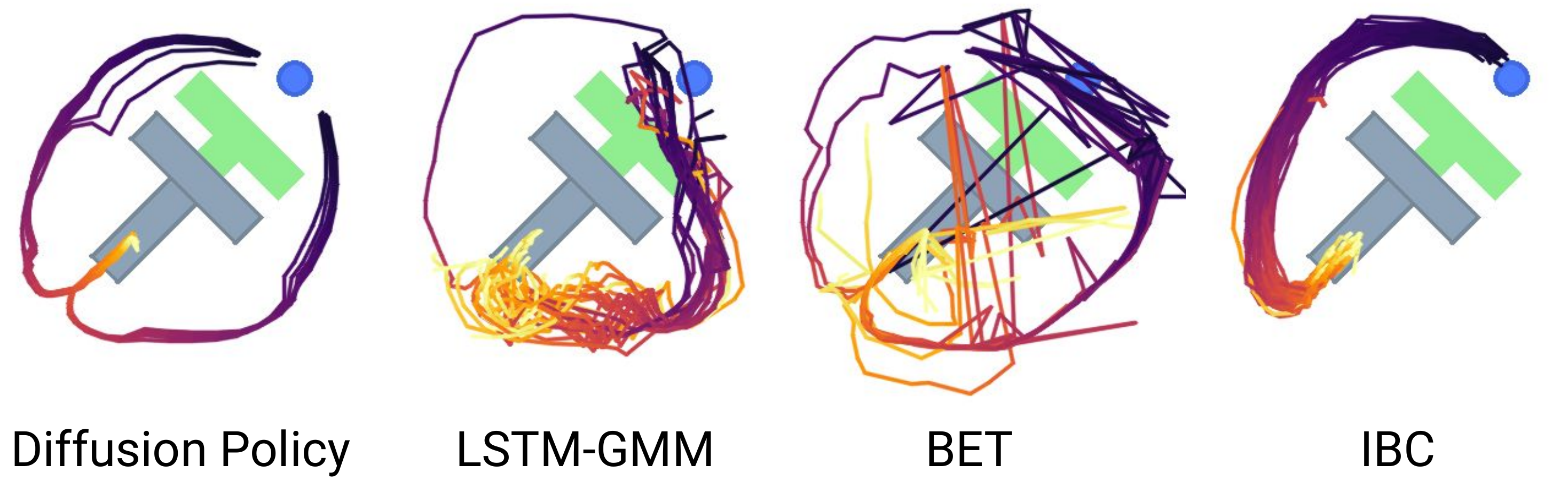
Policy representation, full architecture, and multimodal behavior
These are the authors' original diagrams from the paper. They connect the abstract score-field view to the deployed visuomotor policy and its observed behavior.
The mental model
Ordinary behavior cloning asks a network to output the correct action directly. That is awkward when several actions are valid. Averaging them can produce an action that belongs to no successful behavior. Diffusion Policy instead learns how to move a noisy action sequence toward regions that look like demonstrations.
At inference time, the policy samples a whole sequence from noise. A CNN or Transformer repeatedly predicts the noise to remove while conditioning on recent images and robot state. The result is a temporally coherent plan that can preserve distinct modes, such as going around the left or right side of an obstacle.
The robot does not blindly execute the whole prediction. It commits to a short prefix, collects new observations, and replans. This receding-horizon loop combines the consistency of sequence prediction with the responsiveness of closed-loop control.
Sources