Embodied Reasoning and Test-time Scaling
Notes from Lecture 10 of Robot Learning: From Fundamentals to Foundation Models, taught by Oier Mees.
Related: Embodied Chain-of-Thought | Efficient Embodied Reasoning | Test-time compute scaling | Visual-RFT | Argos
The core question is whether a robot that thinks before acting can generalize beyond the demonstrations it has already memorized.
More robot data gives a better prior, but not intelligence by itself
Scaling robot data is still important. It teaches the policy what successful behavior tends to look like.
But data mostly compresses the demonstration distribution into the model weights. If the robot sees a strange object, a weird instruction, or a situation that was not represented in the dataset, it may still fail.
The lecture frames reasoning as the missing ingredient: the ability to recombine known facts and skills into a new solution.
Reasoning is valuable because it is compositional
A model that only imitates demonstrations needs a close match between the current situation and the training data.
A model that reasons can break the situation into reusable pieces: what object matters, what subtask comes next, what motion is physically sensible, and what could go wrong.
That is why reasoning matters for out-of-distribution robot behavior. The robot does not need to have seen the exact scene before if it can work through the scene from known building blocks.
Embodied reasoning asks the policy to look, plan, then act
The first major example is Embodied Chain-of-Thought reasoning, or ECoT.
Instead of mapping directly from image + instruction to action tokens, the model first predicts intermediate reasoning.
That reasoning can include the task plan, the next subtask, relevant objects, motion traces, and where the end effector should interact before the policy predicts robot actions.
Plain language reasoning is not enough for robot control
A robot policy cannot only say something vague like pick up the object.
It has to ground that instruction in the physical scene: which object, where it is, how the gripper should move, and what part of the scene matters for the next action.
So embodied reasoning adds visual and motion grounding, not just abstract verbal explanation.
Synthetic reasoning labels make ECoT scalable
The problem is that humans cannot manually annotate every robot trajectory with plans, bounding boxes, gripper traces, and subtasks.
ECoT solves this by using internet-scale foundation models to annotate existing robot datasets with grounded reasoning traces. This is similar to the idea in molmo motion paper.
The key win is that the model gets extra reasoning supervision without collecting additional robot demonstrations.
The action tokens become conditioned on the reasoning tokens
ECoT trains an autoregressive vision-language-action model to produce reasoning first and actions second.
The action prediction is therefore not made from the raw observation alone. It is conditioned on the model's own plan and grounded interpretation of the scene.
In simple form: observation + instruction -> embodied reasoning -> action tokens.
ECoT improves generalization without more robot teleoperation
The lecture reports that ECoT gave roughly a 30 percent improvement over the OpenVLA-style baseline in challenging out-of-distribution real-world scenarios.
Those scenarios included unseen objects, unusual spatial relations, and unseen instructions.
The important point is not only the number. The important point is that better generalization came from changing the training target, not from collecting more robot data.
Readable reasoning makes failures easier to debug
Because the intermediate reasoning is human-readable, you can inspect what the robot thinks it is doing.
If it selects the wrong object, predicts the wrong subtask, or grounds the motion incorrectly, the failure becomes visible before the action happens.
The lecture also highlights an interactive benefit: if a human edits the reasoning chain during inference, the downstream action tokens can change because they are conditioned on that edited reasoning.
Reasoning can transfer to robots it was not explicitly trained on
One striking result is that reasoning trained on one robot dataset can still produce plausible reasoning on other Open X-Embodiment robots.
The explanation is that many reasoning tasks are close to what vision-language models already learned during pretraining: object localization, spatial relations, and task descriptions.
ECoT is partly unlocking capabilities already inside the VLM backbone, then tying them to robot action.
The obvious catch is latency
Full embodied reasoning is slow because the model generates many extra tokens before every action.
The lecture contrasts the baseline OpenVLA speed, around 4 actions per second, with the first embodied-reasoning rollouts that could take 4 seconds per action.
That is painful for real-time control. A robot cannot pause for a long reasoning paragraph every time it needs to move a gripper by a few centimeters.
So the next question is why reasoning works
If reasoning helps but is too slow, we need to know what part of it is doing the useful work.
Is the benefit from better representations, a better learning curriculum, or simply more test-time compute from generating extra tokens?
Understanding that mechanism tells us whether we can train with reasoning but deploy without it.
Hypothesis 1: reasoning teaches better representations
The first hypothesis is that reasoning traces make the model build richer visual and semantic representations.
By predicting object locations, motion traces, and subtasks, the model learns which parts of the scene matter for action.
If this is the main effect, then reasoning can be used as training supervision, while the deployed policy can skip generating reasoning tokens.
Hypothesis 2: reasoning acts like a curriculum
A pretrained VLM is used to image-question answering and language tasks, not continuous robot control.
Directly fine-tuning it from pixels to low-level actions is a sharp jump.
Reasoning may provide an easier bridge: first learn intermediate descriptions of movement and task structure, then learn how those descriptions connect to action.
Hypothesis 3: extra tokens give the transformer more compute
Another possibility is that the reasoning tokens work partly as scratch space.
Even if the tokens were not semantically meaningful, extra autoregressive steps might let the transformer perform more hidden computation before predicting an action.
This creates the important question: is embodied reasoning helping because of its content, or because it gives the model more computation at inference time?
ECoT-Lite tests whether reasoning can be internalized
The lecture discusses efficient embodied reasoning strategies that isolate these hypotheses.
The key result is that reasoning pretraining and reasoning dropout can remove reasoning at test time while preserving much of the benefit.
Meaningless thinking-token style variants do not explain the whole gain, which suggests grounded reasoning supervision matters, not only extra token count.
Reasoning pretraining separates learning to reason from learning to act
Reasoning pretraining uses two stages.
First, the VLA is trained to predict embodied reasoning traces. Then it is fine-tuned to predict robot actions without generating those traces at inference time.
This is especially useful when reasoning data and robot action data are not perfectly paired, such as when reasoning comes from simulation, videos, or human activity data.
Reasoning dropout gives one model with two speeds
Reasoning dropout trains the model jointly on reasoning and actions, but randomly drops the reasoning during training.
That forces the policy to learn both modes: acting with explicit reasoning and acting without explicit reasoning.
At deployment, you can choose the slower, more interpretable mode or the faster control mode depending on the task's latency budget.
The practical tradeoff is generalization versus control frequency
Full ECoT gives the best generalization, but it costs inference speed.
Reasoning pretraining and reasoning dropout are slightly weaker in performance, but they recover control frequencies close to the baseline VLA.
This is the robotics version of a familiar tradeoff: thinking more can help, but control loops need to stay fast.
Test-time scaling asks whether hard problems deserve more thought
The second half of the lecture shifts from fixed reasoning to adaptive test-time compute.
Instead of always spending the same amount of reasoning per problem, the question becomes: can harder problems benefit from more inference-time computation?
This is close to planning, but in modern neural systems the search may happen over generated thoughts, candidate answers, verifier scores, or action plans rather than a fully hand-coded state space.
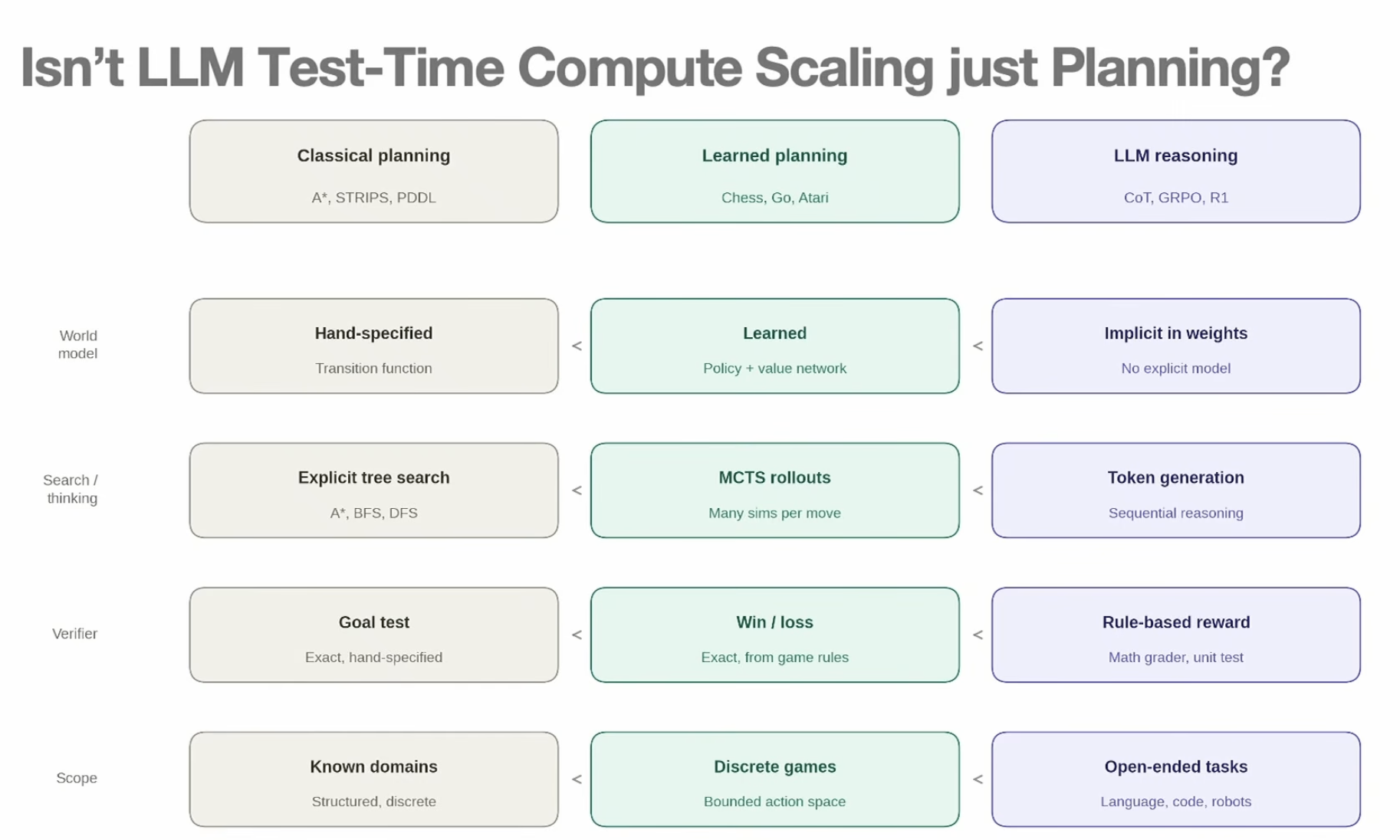
AlphaGo shows how powerful search can be
AlphaGo is the canonical example of test-time compute paying off.
The raw policy network is much weaker than the system with Monte Carlo tree search added at inference time.
The lesson is that a smaller learned policy plus search can beat what the policy alone would do, because the search lets the system evaluate and refine possible futures.
In language, test-time compute helps only when the answer is reachable
The lecture uses work by Charlie Snell and collaborators to show that test-time compute can beat a much larger model in a FLOPs-matched comparison.
But there is an important nuance: test-time compute amplifies what the model already knows.
If the correct answer is nowhere in the model's output distribution, generating and verifying more candidates will not magically recover it.
Reasoning tokens let a transformer unroll serial computation
A single transformer forward pass has fixed depth, so it can only perform a limited number of sequential computation steps.
When the model generates intermediate reasoning tokens autoregressively, it gets additional forward passes.
That means a constant-size model can solve problems requiring more serial steps by thinking longer, rather than needing all computation packed into one pass.
Prompted chain-of-thought was the first simple version
The original chain-of-thought idea was simple: show the model a few examples where reasoning steps are written out, then ask it to do the same on a new problem.
This works much better for strong, large base models than for small ones. (100B+ param models)
The limitation is brittleness. Prompted reasoning depends on the chosen examples and does not necessarily teach the model a robust reasoning behavior.
Training reasoning directly is stronger than merely prompting it
Modern reasoning models are not just following a clean human-written reasoning template.
DeepSeek-R1-style behavior shows a model learning to revise, second-guess, and explore alternatives through reinforcement learning on verifiable outcomes.
The reasoning process may look messier than a human-written chain, but it can be more powerful because it is optimized for solving the task rather than imitating a neat explanation.
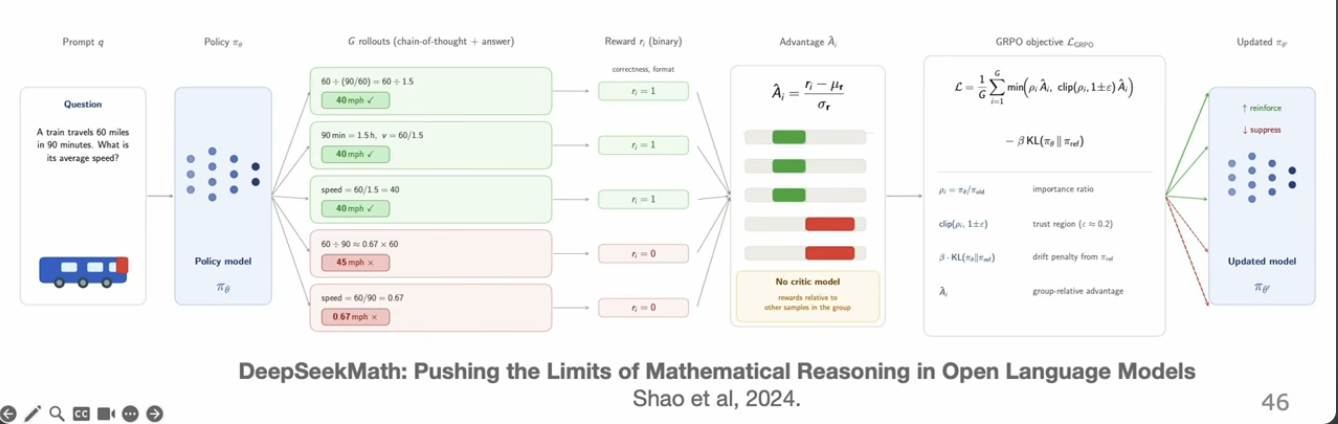
GRPO trains reasoning by comparing a model's own attempts
Group Relative Policy Optimization, or GRPO, avoids training a separate value function.
For one problem, the model samples a group of candidate rollouts. Each rollout's reward is compared against the group's mean and standard deviation.
The model learns which of its own attempts are better, without needing human labels, a reward model, or a critic network in the classic PPO sense.
RL only works once the base model sometimes succeeds
If the base model never produces a correct answer, there is no useful success signal to reinforce.
Modern LLMs became strong enough to occasionally solve hard problems on their own.
Once that threshold is crossed, reinforcement learning can amplify the behavior that led to success, including the habit of pausing, checking, and reasoning more carefully.
Visual-RFT shows the same recipe can work for vision
In visual reinforcement fine-tuning, the reward does not have to be a math answer.
For object localization, the verifier can be a geometric metric like IoU (intersection over Union) between the predicted bounding box and the ground truth box.
This means GRPO-style learning can reinforce visual reasoning when the final output can be checked automatically.
Final-answer rewards are not enough for multimodal reasoning
A vision model can sometimes give the right answer while describing the scene incorrectly.
For example, it might hallucinate a visual explanation but still output a correct bounding box by pattern matching.
That is dangerous for robotics because the robot's intermediate reasoning should be grounded in what it actually sees, not just accidentally correlated with a correct final output.
Argos rewards grounded reasoning, not just correct answers
Argos addresses this by verifying intermediate reasoning as well as the final answer.
It can choose different verifiers per sample, including checks for spatial localization and temporal grounding across images or videos.
The idea is to stop the model from hallucinating its way to a correct answer by making the reasoning trace itself part of the reward.
RL-style reasoning helps first at the high-level planning layer
The lecture says test-time reasoning gives large gains on high-level embodied planning tasks, such as simulated navigation and task-decomposition benchmarks.
On harder tasks, RL-trained reasoning can outperform supervised chain-of-thought models by several times.
That suggests there is a difference between imitating reasoning traces and actually learning a reasoning strategy that improves reward.
Continuous control still needs fast, internalized reasoning
High-level planning can afford more thinking than a low-level control loop.
For continuous action prediction, generating full reasoning chains at every timestep is usually too slow.
That is why the lecture returns to ECoT-Lite-style internalization: train with reasoning, bake the useful representations into the policy, and drop explicit reasoning at deployment.
The emerging architecture has two reasoning levels
One level is slow and deliberate: an RL-trained reasoning system for task decomposition, high-level planning, and deciding what should happen next.
The other level is fast and reactive: a control policy that has internalized embodied reasoning but does not verbalize every thought before every action.
This is a practical way to combine intelligent planning with real-time robot control.
The lecture's four takeaways
First: test-time compute is a new scaling axis, and sometimes it is more efficient than only scaling pretraining.
Second: for continuous control, the robot can train with reasoning but avoid paying the reasoning-token cost at inference time.
Third: reinforcement learning can make reasoning emerge because reasoning becomes the best strategy for getting reward, not because humans wrote reasoning traces.
Fourth: for multimodal agents, verifying the reasoning trace matters as much as verifying the final answer.
The open problem is one robot policy that can reason, adapt, and act fast
The field is trying to bring together several pieces: VLA pretraining, embodied reasoning, test-time compute, RL with verifiable rewards, grounded multimodal verification, and low-latency control.
Each piece solves part of the puzzle, but combining them into one robust robot policy is still open.
That is why the lecture frames embodied reasoning and test-time scaling as one of the active frontiers in robot learning.